Using the Generated Artifacts
... or, "Now What?"
The MetaEd IDE generates a number of technical artifacts, which you can find in the Explorer in the MetaEdOutput directory. We figure you wouldn't be here if you didn't have a solid working knowledge of Ed-Fi Technology Suite — but a few pieces of information are worth covering.
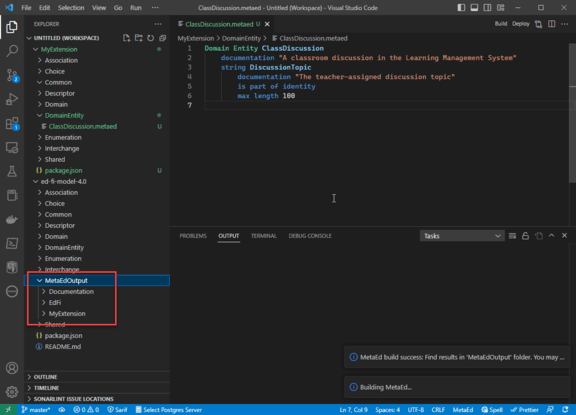
Generated SQL
The MetaEd IDE generates a number of SQL script artifacts, which can be found in the ODS-SQLServer directory. These include Core and Extended database tables for the Ed-Fi ODS, and related SQL structure scripts such as index declarations. These files are used by the Ed-Fi ODS / API software, in particular, its code generation cycle.
The SQL files are prefixed by a number. Generally speaking, there are several new SQL files, most of which have "EXTENSION" in the name. These are additive to the set of scripts that ship with the Ed-Fi ODS / API. There are other scripts with the same name as files that ship with the ODS / API — these are intended to replace the files with the same name.
The generated files are:
0001-Schemas.sql- the Ed-Fi core database schema definitions.0001-EXTENSION-extension-Schemas.sql- The database schema definitions for the extensions provided, using the default "extension" namespace.0004-Tables.sql- the Ed-Fi core database tables.0004-EXTENSION-extension.sql- the extension database tables, using the default "extension" namespace.0009-IdColumnUniqueIndexes.sql- an indexing update to the Ed-Fi core tables for API support.0009-EXTENSION-extension-IdColumnUniqueIndexes.sql- the same indexing update for extensions, using the default "extension" namespace.
See the Ed-Fi ODS / API documentation for more detail on the SQL files and the code generation process.
Generated XSD
The MetaEd IDE generates XSD artifacts aligned with the SQL script artifacts, and are found in the XSD and Interchange folders. These generally include an Extended XSD core and one or more additional Interchange Files. These files define the structure for bulk data exchange and bulk loading of Ed-Fi data. XSD artifacts are also used as part of the Ed-Fi ODS / API code generation process.
The generated files are:
Ed-Fi-Core.xsd- the Ed-Fi core XSDEXTENSION-Ed-Fi-Extended-Core.xsd- the XSD for the extension, using the default "extension" namespace.SchemaAnnotation.xsd- definitions of annotations in an Ed-Fi XSD.Interchange-\*.xsd- the interchanges in Ed-Fi core.EXTENSION-Interchange-\*.xsd- the interchanges for the extension, using the default "extension" namespace.
See the Ed-Fi ODS / API documentation for more detail.
Generated API Metadata
The MetaEd IDE generates a number of metadata files used by the Ed-Fi ODS / API.
These can be found in the ApiMetadata folder, and include DomainMetadata.xml,
DomainMetadata-Extension.xml and EdOrgReferenceMetadata.xml. They provide
directives to the Ed-Fi ODS / API build process.
Generated Data Dictionaries
The MetaEd IDE generates two data dictionaries in the DataDictionary folder. The
Ed-Fi SQL Data Dictionary provides documentation on the core and extension
tables generated by MetaEd. This is an Excel file
named SqlDataDictionary.xlsx. The Ed-Fi XSD Data Dictionary
provides documentation on core and extension XSD elements generated by MetaEd.
This Excel file is named XmlDataDictionary.xlsx.
Generated Data Handbook
The MetaEd IDE generates a data handbook that combines both Ed-Fi core and extensions in the Ed-Fi-Handbook folder. The data handbook takes several forms, but each one contains the same comprehensive information.
The generated files are:
Ed-Fi-Handbook.xlsx- An Excel version of the data handbookEd-Fi-Data-Handbook-Index.html- An interactive and searchable version of the data handbook.
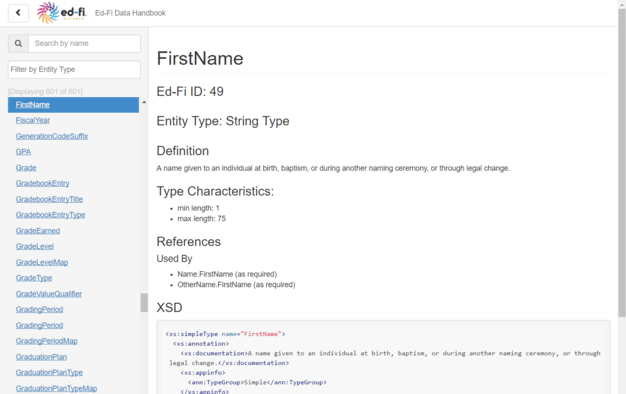
The HTML version of the data handbook is a self-contained file that can be run locally or hosted on a web server. An example of the output is shown below:
API Catalog
New in MetaEd 4.7, released in May 2028.
This Excel spreadsheet contains two tabs: Resources and Properties. These describe components of the data model as they will be translated into the Open API ("Swagger") specification in the Ed-Fi API. In other words, this spreadsheet matches what API clients actually see in production, whereas the Data Handbook above describes only the conceptual data model.
The Resources tab contains:
| Column | Example |
|---|---|
| Project | "ed-fi" or the extension name |
| Version | 5.2.0 |
| Resource Name | applicantProfiles |
| Resource Description | The profile of the person making an application. |
| Domains | RecruitingAndStaffing |
The Properties tab contains:
| Column | Example |
|---|---|
| Project | "ed-fi" or the extension name |
| Version | 5.2.0 |
| Resource Name | applicantProfiles |
| Property Name | lastSurname |
| Property Description | The name borne in common by members of a family. |
| Data Type | string |
| Min Length | |
| Max Length | 75 |
| Validation RegEx | |
| Is Identity Key | false |
| Is Nullable | false |
| Is Required | true |
The file will be named Ed-Fi-API-Catalog.xlsx and will appear in the Ed-Fi-API-Catalog folder.
Artifact Deployment for ODS / API Builds
The MetaEd IDE can deploy the generated artifacts necessary for an ODS / API build of an extension project. These include the generated SQL, generated XSD, and generated API metadata.
Assuming you have a working ODS / API build environment on your machine, you can easily configure the MetaEd IDE to copy the generated files over to the correct locations for the ODS / API project.
See How To: Extend the Ed-Fi ODS / API - Student Transportation Example for more information on creating the related C# project.
First, ensure that your Ed-Fi ODS / API source directory is set properly in the MetaEd IDE settings.

Then, deploy by selecting MetaEd > Deploy from the menu bar. Click OK on the confirmation dialog.
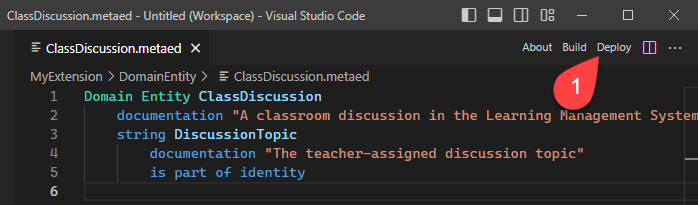
This will run a new build of all artifacts, and the artifacts required for the ODS / API will be copied over to the correct locations.