API Claim Sets & Resources
The Ed-Fi ODS / API provides access to the data stored in an underlying Ed-Fi ODS database only to authorized users and applications. The API is capable of authorizing requests to a granularity of individual API resources while also taking into consideration the caller's relationship to or ownership of the data in question.
For example, a student information system (SIS) vendor can be authorized to read and write student and staff data, but only for students and staff associated with the local education agencies the vendor serves. An assessment application, on the other hand, can be authorized to manage assessment metadata and results that are specifically tied to its own assessments. These distinctions are enforced through a combination of claim sets, resource claims, and authorization strategies, all of which are described in the sections below.
The key concepts and implementation information follow.
API Resources
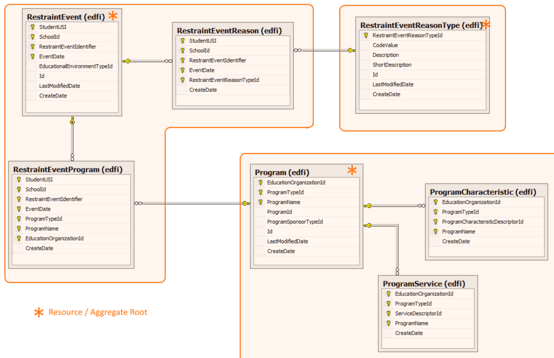
The database tables of the Ed-Fi ODS are organized into mutually exclusive groups based on the Domain Driven Design principles for defining aggregates. Each table in the database belongs to a single aggregate, but an aggregate can contain many tables. Each aggregate has an aggregate root, which is the table that represents the top-level element of the exposed object graph. In the Ed-Fi ODS / API, aggregates are exposed as resources.
While there is some good material available on how to determine the most appropriate boundaries for an aggregate in Domain Driven Design, from the perspective of creating Ed-Fi data model representations, there is one main consideration when creating new aggregates or extending an existing aggregate. Each aggregate represents an object graph consisting of a single root object, and may contain subordinate objects (i.e., objects contained in child collections within the object graph). In order for a subordinate object to reference an object external to the graph (generally representing the back-reference of a many-to-one relationship), the target object must be the root of its own aggregate.
The reason for this is obvious if you consider how that outbound link would be represented in JSON:
"schoolReference": {
    "schoolId": 255901107,
    "link": {
      "rel": "School",
      "href": "/schools?schoolId=255901107"
    }
The outbound href attribute must directly reference a resource available on
the ODS / API, which by definition would be an aggregate root.
A further implication of this rule for modeling is that the parent object of a one-to-many relationship must either have its children modeled as a collection within the same aggregate, or it must be an aggregate root itself (so that the back-references from the children can be represented as direct URLs).
The figure below shows a sample of resources related to restraint events.
Claims
Authorization decisions for API requests from a consumer application are claims-based. Each consumer of the API must be issued a key and secret by a system administrator. The key and secret allow the ODS / API system to issue an access token at runtime. The access token must be included with all API requests. Additionally, the consumer application's key will be associated with a specific claim set (i.e., a role). When the consumer calls the Ed-Fi ODS / API, the server will add a collection of resource claims to the request's context based on the associated claim set, and the security infrastructure will subsequently use those claims to make authorization decisions.
For example, a Student Information System (SIS) vendor's token might be given a claim to read the Education Organization data, but a token supplied by an approved System Data Administrator would generally receive claims to read, write, and delete data.
In most cases, the API now treats the claims documented in this section as
conceptual. In .NET, claim values are stored as strings. However, since the API
authorization process requires a richer context, the values for the resource
claims were actually previously represented as JSON requiring serialization and
deserialization during a single request. For performance reasons, the
authorization metadata they represent are now only available to the application
code through purpose-built in-memory objects in the current request context.
With the exception of "service" claims, the implementation no longer creates
.NET Claim objects and adds them to the current principal. Service claims are
still added to the principal, however, to leverage built-in ASP.NET
authorization capabilities for custom developed controllers.
Identity Claims
Identity claims will be issued to enable the authorization layer to access
specific attributes about the caller when making authorization decisions. The
following identity claims are currently represented by in-memory purpose-built
objects available in the current request context (and not created and accessed
as Claim objects):
- Namespace Prefix (
http://ed-fi.org/claims/namespacePrefix) - used to authorize access to resource items where callers need to manage their own data in the Ed-Fi ODS that is not associated with any specific education organizations, such as custom descriptor values and assessment metadata. A consumer could have access to many namespace prefixes, with each namespace prefix defined in association with their "Vendor" record in the Ed-Fi ODS / API Admin database. - Profile (
http://ed-fi.org/claims/profile) - used to apply data policies to the response data returned to a consumer. A consumer could have many assigned profiles, with each profile name defined in association with their "Application" record in the Ed-Fi ODS / API Admin database. - Claim Set Name (
http://ed-fi.org/claims/claimSetName) - used to apply a predefined set of claims to the consumer (as defined in the Ed-Fi security database). A consumer can only be assigned a single claim set, the name of which is defined in their associated "Application" record in the Ed-Fi ODS / API Admin database. - Ownership Token Ids (
http://ed-fi.org/claims/ownershipTokenId) - used to perform "Ownership Based" authorization. The consumer has an associated "creator" token (assigned through the "ApiClient" record in the Ed-Fi ODS / API Admin database), and a set of "data access" tokens (assigned through "ApiClientOwnershipTokens" records). - Education Organization Ids - used to identify the education organizations whose data the consumer can access. For example, a SIS vendor would have permissions to manage student data, but only for students enrolled in schools within the local education agencies they serve. The education organization ids associated with the consumer are managed in the Ed-Fi ODS / API Admin database.
Service Claims
Service claims are defined in the Ed-Fi ODS / API Security database with a claim
name using a prefix of http://ed-fi.org/claims/services/. These are the only
type of claims that are actually created as Claim objects and added to the
consumer's authenticated principal. They can be used to perform authorization on
additional services exposed through the API such as the Identity management
services using the built-in ASP.NET architecture (e.g. ASP.NET security
policies). The value of each service claim will contain a comma-separated list
of the associated Action URIs.
Resource Claims
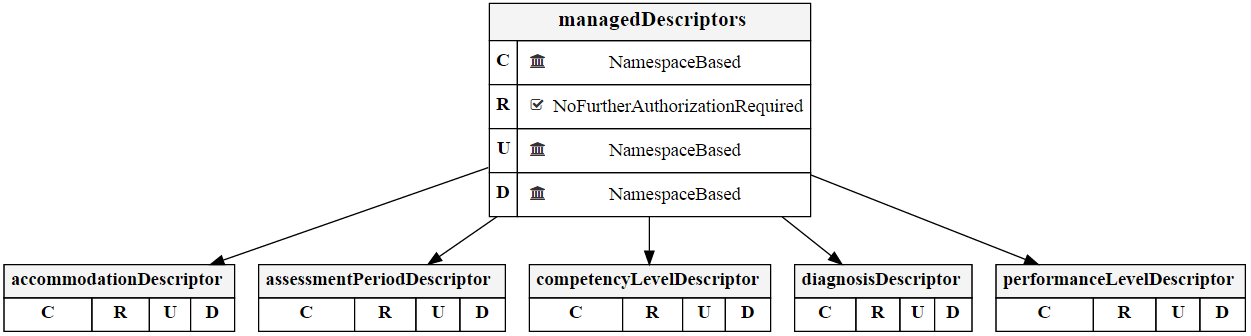
The claims used for API resource authorization are based directly on the resources exposed by the API, and as such can be referred to as resource claims. Due to the large number of resources, however, they have also been organized into a claims taxonomy. While resource claims can be issued for individual resources, in most cases they will be issued for a higher level conceptual grouping. For example, rather than issue resource claims for each individual type of descriptor, the broader "systemDescriptors" or "managedDescriptors" resource claims will be issued instead.
Resource Claim Values
The base security metadata for a claim set's resource claims will also contain the actions that can be performed on the resource, along with any action-specific authorization strategy overrides. The API client context will provide access to the list of education organization identifiers that have been associated with the consumer in the Ed-Fi ODS / API Admin database.
Actions
The Ed-Fi ODS / API supports basic CRUD operations. Thus, the primitive actions
that can be added to claims include Create, Read, Update, and
Delete. The actions are expressed as URIs, such as
https://ed-fi.org/ods/actions/create.
Claims Taxonomy
As described above, the claims taxonomy organizes the granular resource claims into higher-level logical groupings. However, the metadata contained in the taxonomy also identifies authorization strategies for the various claims that are applied after the basic "action" checks have been performed. The figure below shows a representative piece of the Ed-Fi ODS / API claims taxonomy.
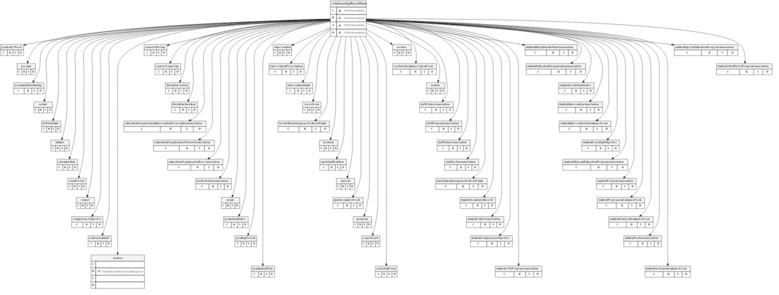

The strategy used to authorize a request for an Ed-Fi type or descriptor is different from the one used to authorize a request to modify student-related data. The former is a straightforward check against the caller's claims for the requested action on the resource. The latter must also take into account the relationship between the caller and the student.
The authorization strategy may also differ based on the action in the request,
such as with the case of creating vs. reading or updating a student (see the
"people" resource claim in the figure above). To create a student record, a SIS
vendor only needs the "student" (or "people") resource claim with an associated
action of "Create" — no further authorization is performed. This is intentional:
when a student is being created for the first time, no association records exist
yet. Requiring a relationship to already exist would make it impossible to ever
write the foundational records that establish that relationship. However, to
read or update a student, the SIS vendor must not only have been granted the
appropriate action, but must also have an established relationship with the
student (through the StudentSchoolAssociation resource). As the diagram
indicates, this is handled by the
RelationshipsWithEdOrgsAndPeople
strategy.
Claims Taxonomy Hierarchy and Strategy Resolution
Resource claims are organized as a hierarchy in the Ed-Fi Security database (for
example, student is a child of people, which is a top-level domain claim).
When authorization is evaluated for a specific resource, the system first checks
for a directly configured authorization strategy. If none is found, it walks up
the parent chain until it finds a configured strategy. This means a new
extension resource can inherit appropriate authorization behavior simply by
being placed under the correct parent claim in the taxonomy, without requiring
explicit per-resource configuration.
Claim Set Authorization Strategy Overrides
While the claims taxonomy defines default authorization strategies for each
resource-action combination, these defaults can be overridden at the claim set
level. For example, a specialized claim set could override the default
RelationshipsWithEdOrgsAndPeople strategy on students to use
NoFurtherAuthorizationRequired for a trusted administrative tool. These
overrides are stored in the
ClaimSetResourceClaimActionAuthorizationStrategyOverrides table in the Ed-Fi
Security database and take precedence over both the resource-level defaults and
any parent-inherited strategies.
Authorization Strategies
The implementation of the Ed-Fi ODS / API includes several authorization strategies, applied to the claims taxonomy shown in the figure above.
- NoFurtherAuthorizationRequired. Explicitly performs no additional authorization beyond resource/action verification. Used for actions where no relationship check is possible or necessary (such as creating a record for the first time).
- NamespaceBased. Allows access to items based on the caller's NamespacePrefix claim. A resource's namespace value must start with at least one of the caller's assigned namespace prefixes. NamespacePrefix values are assigned when a vendor's record is created.
- Relationship-based strategies. A family of strategies that authorize access to student and education organization-related data through ODS relationships, from the perspective of the education organization(s) contained in the caller's claims. See Relationship-Based Authorization for more details.
- OwnershipBased. Allows access to items based on ownership tokens associated with the caller. The caller is granted access to a resource when the token captured at creation time matches an ownership token in the caller's claims. This strategy is available when the "OwnershipBasedAuthorization" feature is enabled by the API host, which is required to capture the ownership token at each aggregate root at write time. See Ownership-Based Authorization for more details.
How Authorization Is Enforced
With the concepts of resource claims, actions, the claims taxonomy and authorization strategies in place, authorization for every API request is enforced in two sequential phases:
- Resource claim and action check. Does the caller's assigned claim set include the requested resource and the action being performed (Create, Read, Update, or Delete)?
- Authorization strategy check. Given that the claim exists, does the associated authorization strategy validate the specific data being accessed? For example, does the caller have an established relationship in the ODS to the education organization or person referenced in the resource?
Both phases must pass for the request to be allowed. The authorization strategy applied in phase 2 varies by resource and action. Claim set level overrides can also be configured.
Relationship-Based Authorization
Many of the Ed-Fi ODS / API resources contain sensitive data subject to FERPA regulations. Access to this data is authorized based on the caller's relationship to the specifically requested resource.
Education Organization Hierarchy
When an API client is associated with an education organization (such as a district), that association is automatically extended to all subordinate education organizations in the hierarchy (such as schools within that district). The ODS maintains a transitive closure of the education organization hierarchy, so a caller with access to a parent education organization implicitly has access to all of its descendants. This means a SIS vendor associated with a district does not need separate configuration for each individual school within that district.
Primary Relationship Tables
In the Ed-Fi ODS data model, the following tables have been identified as the "primary" relationship tables that define the relationships between people and organizations for authorization purposes:
- StudentSchoolAssociation. Represents a student's enrollment at a particular school. This is the most common path for establishing an API caller's relationship to student data.
- StudentEducationOrganizationResponsibilityAssociation. Used to identify an
education organization that is responsible for the student, providing an
alternative authorization path to
StudentSchoolAssociation. - StudentParentAssociation/StudentContactAssociation. Associates a parent/guardian with their student(s), enabling authorization of parent-related resources.
- StaffEducationOrganizationAssignmentAssociation. Captures a staff member's assignment to an education organization (typically a school or local education agency).
- StaffEducationOrganizationEmploymentAssociation. Captures a staff member's employment by an education organization (typically a school or local education agency).
How Relationship Paths Are Evaluated
The essence of all relationship-based authorization strategies is to determine whether a path can be established through the primary relationship tables in the ODS between the education organization(s) associated with the API caller and the education organization and/or person associated with the targeted resource.
For GET (list) requests, this check is performed as a JOIN against the relationship tables, filtering results to only those records reachable through the caller's education organization associations. For GET-by-id, PUT, and DELETE requests, it is performed as an existence check before the operation proceeds.
Relationship-Based Strategy Variants
- RelationshipsWithEdOrgsAndPeople. The general-purpose strategy for
FERPA-sensitive resources. Both education organization and person identifiers
on the targeted resource must be reachable through the caller's education
organization associations and the primary relationship tables. For example,
authorizing a
CourseTranscriptchecks both theEducationOrganizationIdand theStudentUSIfields. - RelationshipsWithEdOrgsOnly. Authorizes based solely on education
organization identifiers. Person identifiers (student, staff, contact) on the
resource are ignored. This is also the strategy used to authorize creation of
the primary relationship records themselves (such as
StudentSchoolAssociationandStaffEducationOrganizationAssignmentAssociation). Because these records are what establish a person-to-education organization relationship, requiring a person-level check before they can be written would create a circular dependency — the record needed to authorize the write is the same record being written. - RelationshipsWithPeopleOnly. The inverse: authorizes based solely on person identifiers and ignores education organization fields on the resource.
- RelationshipsWithStudentsOnly. A narrower variant that considers only student-specific relationship paths, disregarding contact, staff, and education organization fields.
- RelationshipsWithStudentsOnlyThroughResponsibility. Same as
RelationshipsWithStudentsOnlybut establishes the student relationship viaStudentEducationOrganizationResponsibilityAssociationrather than the standardStudentSchoolAssociation.
Example
When a SIS vendor sends a request to create a restraint event (see the figure
above in the API Resources section), the resource to be
written will be associated with a particular school and student. The
"RelationshipsWithEdOrgsAndPeople" authorization strategy will evaluate whether
the SIS vendor's education organization(s) have an established path to that
school (via the education organization hierarchy) and to that student (via
StudentSchoolAssociation or another primary relationship table). If such a
path exists, authorization is granted. If not, the request is rejected with an
HTTP 403 response and a descriptive error message identifying which relationship
is missing, for example:
No relationships have been established between the caller's education organization(s) and the resource. Verify that a StudentSchoolAssociation exists for the referenced student and school.
Ownership-Based Authorization
Though the relationship-based authorization strategy is sufficient for most implementations, there are use cases with overlapping local contexts where education-organization-based authorization lacks the granularity necessary for controlling data access — for example, private schools that students from multiple LEAs attend for special education needs. In such cases, the ownership-based authorization strategy is typically applied in conjunction with the relationship-based authorization strategy.
When both strategies are configured for a resource, both must pass: the relationship-based check confirms the caller's education organization has a path to the resource, and the ownership-based check then further filters to only those records that were originally created by a caller with a matching ownership token. This AND combination ensures that overlapping-context scenarios do not inadvertently expose one LEA's data to another.
This strategy authorizes access to individual resources based on the concept of "ownership". Each API caller has an associated "Ownership Token" that is captured with each resource the caller creates. The API caller's claims information also includes a list of "Ownership Tokens" that can be used to identify which resource items they currently "own", and the authorization process will filter results to matching "Ownership Token" values stored with the resources.