Ed-Fi Overview and Implementation Playbook
Last updated: July 29, 2026
Download Ed-Fi State Education Agency Playbook V2 (PDF)
This playbook provides an overview of the Ed-Fi Technology Suite and practical guidance for State Education Agencies (SEAs) implementing Ed-Fi Data Standard for data modernization. It covers the problem space, available implementation approaches, a phased timeline, and best practices for vendor and LEA coordination.
Data Pain Points
States and districts share related but distinct data challenges.
State Education Agencies:
- Timeliness — responding to legislative data requests can take weeks or months
- Data quality — data received from districts is often in different formats and missing information
- Costly collection — the average SEA employs 10–15 FTEs ($1.1M+) to process and clean district data
Local Districts:
- Reporting burden — average of 6 FTEs ($0.5M) per district to collect and format data
- Absenteeism — need earlier alerts of potential chronic absenteeism rather than months later
- Assessments — lack access to a consolidated student-level view of assessment results
- College and Career Readiness — limited visibility into performance against state targets
Ed-Fi Alliance's Mission
The Ed-Fi Data Standard enables data interoperability across K–12 states, districts, and vendors through three pillars:
Impact
State's Real-Time Data Usage Case Study: Indiana Example
Indiana turned a compliance system into a real-time, statewide data foundation using the Ed-Fi Data Standard, providing analytics and data services back to districts.
Challenge
A 20+ year old data system was slow, manual, and error-prone — offering little value beyond meeting compliance deadlines.
Approach
IDOE partnered with the Ed-Fi Alliance and technology providers to adopt the Ed-Fi Data Standard in phases, with ongoing training and district input.
Key Use Cases & Impact
| Use Cases | Impact |
|---|---|
| Student Data Backpack | A complete student profile: enrollment, demographics, special education, and program data. Gives staff key student info instantly when a student changes schools — no more lost records in transfer. |
| GPS Dashboard | A statewide tool tracking Graduates Prepared to Succeed outcomes for every student. Helps educators and families plan and monitor progress toward college and career readiness. |
| Early Warning System | Analyzes attendance, behavior, and course outcomes across current and prior years. Flags students at risk of not graduating — or not graduating on time — so educators can act sooner. |
| Positive Attendance Tracking | A new approach that tracks and celebrates positive attendance trends, not just absences. Helps schools rebuild strong attendance habits after pandemic-related disruptions. |
"Under the old system, schools certified their data weeks or months after submission. Now we're able to certify within two weeks of the count date."
— John Keller, Chief Information Officer, Indiana Department of Education
Statewide District Use Cases: Michigan Example
The Michigan Data Hub turned disconnected district systems into a real-time, statewide data platform built on the Ed-Fi Data Standard.
Challenge
Disconnected district systems couldn't share data, making both state reporting and student supports slow and manual.
Approach
The state, CEPI, and Intermediate School Districts built the Michigan Data Hub on the Ed-Fi Data Standard —connecting school districts in the state with a modern, flexible way to share information.
Key Use Cases & Impact
| Use Cases | Impact |
|---|---|
| MiRead | Supports Individualized Reading Improvement Plans, tracking dyslexia screening and assessments statewide. Turns screening data into instructional strategies teachers use to catch reading gaps early. |
| Snack-Pack | Delivers state-verified student data — EL status, attendance, and more — into a district's SIS at enrollment. Keeps services uninterrupted for highly mobile students changing schools, no re-entry lag. |
| Special Population Support | Tracks services and resources for students who need extra support across districts. Helps schools comply with requirements while delivering timely, coordinated help. |
| Statewide Scale & ROI | 857 of Michigan's 880 districts are live, processing 10M+ transactions a day across the Hub. A 2024 ROI study found $41M+ in annual savings and an 830% return on investment. |
"The ability to obtain immediate information on newly enrolled students has improved our ability to provide timely services. Before we would have to wait for the previous school to send student status related to special education, English language, homelessness, etc., which caused a delay in needed services."
— Sarah Mohler, Madison District
State Reporting Savings: Nebraska Example
Nebraska replaced manual state reporting with automated, real-time data built on the Ed-Fi Data Standard, giving districts time and money back to support students.
Challenge
Staff pulled data from multiple systems and formatted files by hand, fixing errors after submission — often too late to act before deadlines.
Approach
With a federal SLDS grant, Nebraska adopted the Ed-Fi Data Standard to replace manual uploads with automatic data sharing, staying closely aligned to the core standard.
Key Use Cases & Impact
| Use Cases | Impact |
|---|---|
| School Funding Calculations | Districts see how enrollment and program data contributes to state funding calculations. Allows districts to catch problems before they affect funding, not after. |
| Error Validation & Reporting | Real-time validation helps districts fix errors quickly as data is submitted. Improves data quality and speeds up informed, confident decisions. |
| Accountability Reporting | Faster reporting improves transparency in state accountability results. Builds district and public confidence in reported outcomes. |
| Assessment Integration | Assessment vendors connect once through the Ed-Fi API, statewide. Eliminates costly district-by-district customization for vendors. |
$30M in combined state and district savings statewide
10 wks to less than 1 day to compile quarterly EDFacts reporting
Reduction in data burden saving ~$125k per district
Source: Nebraska Department of Education
State Rostering Case Study: South Carolina Example
South Carolina turned a local rostering challenge into a statewide data services system — built with districts and for districts, on the Ed-Fi Data Standard.
Challenge
Data systems were fragmented and outdated —state reports delayed by up to two years, and smaller districts lacking the staff to keep up.
Approach
Starting with student rostering, the state built trust district-by-district, forming the Palmetto Data Collaborative and delivering data tools to improve student outcomes.
Key Use Cases & Impact
| Use Cases | Impact |
|---|---|
| Early Childhood Data | Integrated preschool data gives educators a fuller picture of young learners. Helps teachers spot needs earlier, before gaps widen in later grades. |
| IEP System | A modern, centralized platform for tracking and delivering special education services. Cuts paperwork and gives staff a clearer, shared view of student support plans. |
| College & Career Readiness | One platform combining student perception data with academic progress. Allows educators to tailor support so more students leave ready for what's next. |
| Timely Alerts | Automatic notifications flag events like course drops as they happen. Reaches counselors within 24 hours, so they can respond while it still matters. |
"Creating an environment where these resources are shared freely raises the floor for everyone."
— Dan Ralyea, Chief Innovation Officer, South Carolina Department of Education
Real-Time Average Daily Membership Case Study: Tennessee Example
Tennessee turned average daily membership (ADM) funding into a transparent, near real-time process built on shared, community-built tools.
Challenge
Enrollment data lived across disconnected systems, taking weeks or months to turn into usable funding counts — with no visibility into how the state used it.
Approach
Using the Ed-Fi Data Standard and shared community-built tools, the state created a clearer, faster way to organize enrollment data for funding calculations.
Key Use Cases & Impact
| Use Cases | Impact |
|---|---|
| ADM Funding Dashboards | Shows districts exactly how their enrollment data drives state funding decisions. Districts see the same numbers the state uses, catching issues before dollars are finalized. |
| Dual Enrollment Pilots | Connects high school and community college data for students taking both. Gives a clearer view of student progress across two systems that rarely talk to each other. |
| Statewide Reporting | Aligns assessment, enrollment, and program data into one statewide reporting layer. Cuts duplicate reporting and keeps every dataset speaking the same language. |
| Research-Ready Datasets | Delivers analysis-ready tables in a modern cloud warehouse, no manual prep needed. Frees analysts to spend time on insights instead of cleaning and reshaping data. |
"We are building a stronger foundation for better decision-making and improved student outcomes statewide."
— Vijay Gollapudi, Chief Information Officer, Tennessee Department of Education
Implementation Approaches
There are three primary ways to implement the Ed-Fi Data Standard:
| Approach | Description | Benefits | Tradeoffs |
|---|---|---|---|
| Reporting Only | Deploy Ed-Fi to modernize state reporting | Drives cost savings ($30M+); not dependent on having ESAs | Longest (2.5+ years) time to impact; doesn't address local use cases |
| Data Hub Only | ESAs-led data hub providing local use cases and data services for districts | Shared (2-3 year) time to impact; addresses local use cases; State funds offset (75%) up to limited services | Requires ESA compliance on vendor; Vendor compliance can be mixed |
| Reporting + Data Hub | Data hub addresses local use cases and state defines reporting specs. ESAs map local; state defines reporting | Greatest impact; $30M+ local use cases; Most (1 school year) time to impact; Addresses all of reporting and LEA burden | Requires ESA services model; State + ESA alignment required |
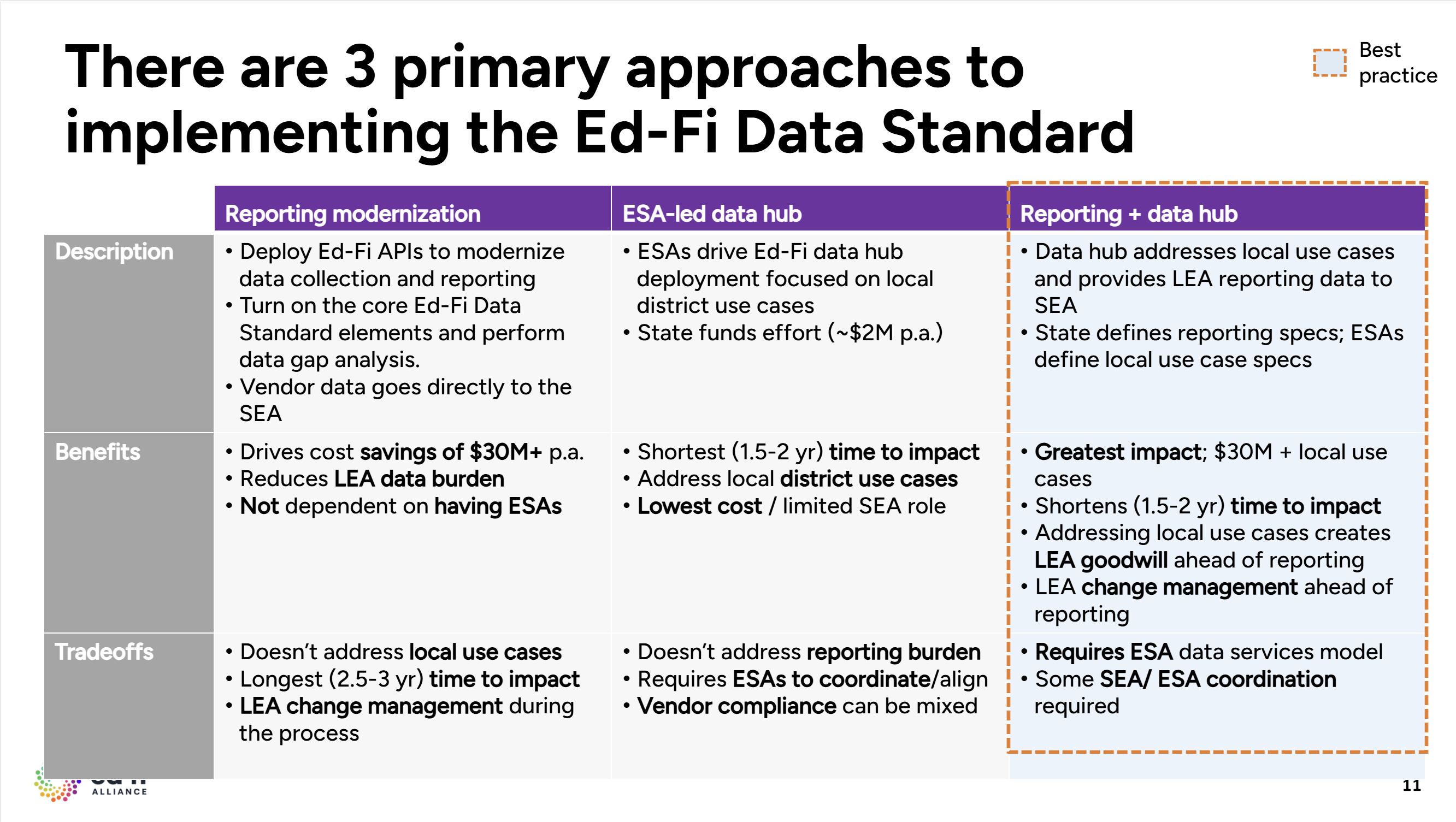
Three primary approaches to implementing Ed-Fi
The Reporting + Data Hub approach is considered best practice where a strong ESA model exists and the state wants to de-risk reporting modernization. It delivers the greatest combined impact: $30M+ in state reporting savings plus local district use case benefits.
What is a Data Hub?
A data hub is a shared enterpise system that enables school districts to collect, store, and use data in one place.
It supports sedcure, standards-based integration across vendor systems, providing insights while maintaining district control.
States operate these hubs to streamline data sharing, support smaller districts and advqance key policy initiatives.
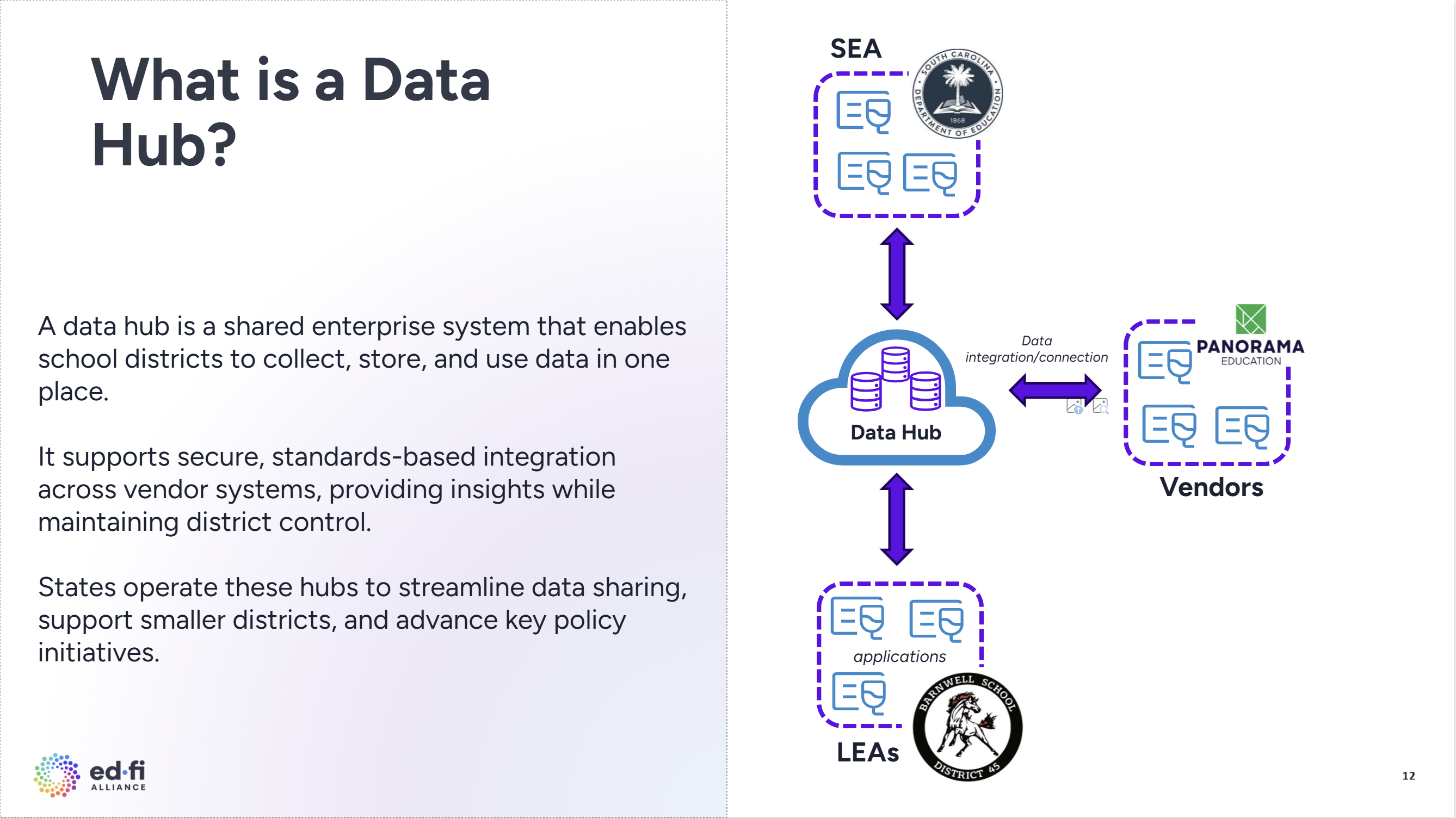
Reporting + Data Hub: Recommended Approach
Implementation Phases
Key activities by phase:
- Planning — RFP to identify a managed provider; ESA-led solution design; data hub funding model; budget ($2.5M for reporting plus any data hub state funding up to $2M)
- Productize / Pilot — develop 2–3 initial local use cases (e.g., absenteeism); launch data hub; turn on Ed-Fi core data submission, perform data gap analysis, pilot state reporting with 5-10 LEAs and vendors
- Parallel — run Ed-Fi-based reporting alongside the legacy system for the full school year to ensure accurate funding
Risk Mitigation
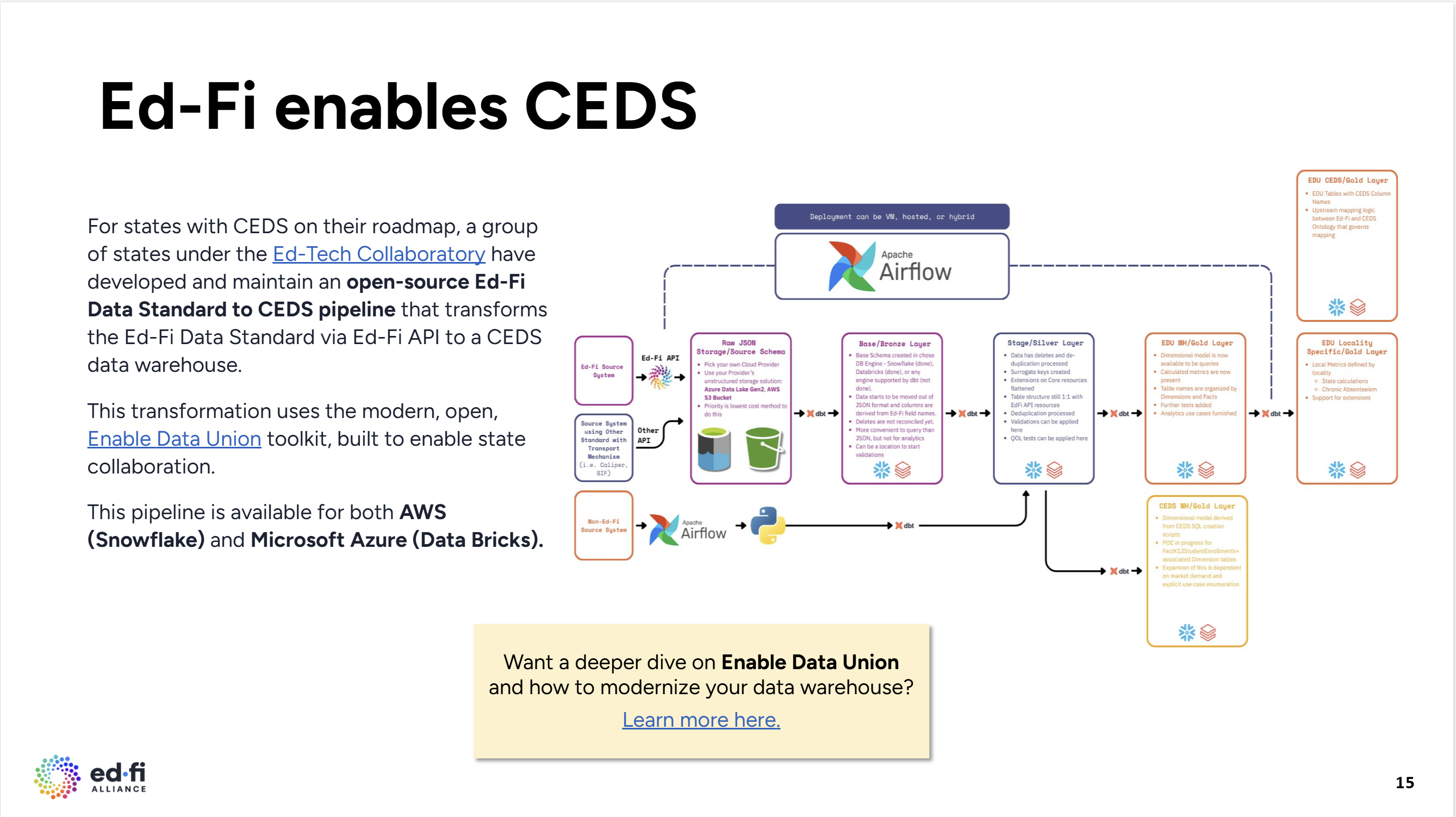
Ed-Fi Enables CEDS
For states with CEDS on their roadmap, a group of states under the Ed-Tech Collaboratory have developed and maintain an open-source Ed-Fi Data Standard to CEDS pipeline that transforms the Ed-Fi Data Standard via the Ed-Fi API to CEDS data warehouse.
Ed-Fi and 1EdTech Working Together
For states using 1EdTech standards, the Ed-Fi and 1EdTech communities have been collaborationg to make these standards work together.
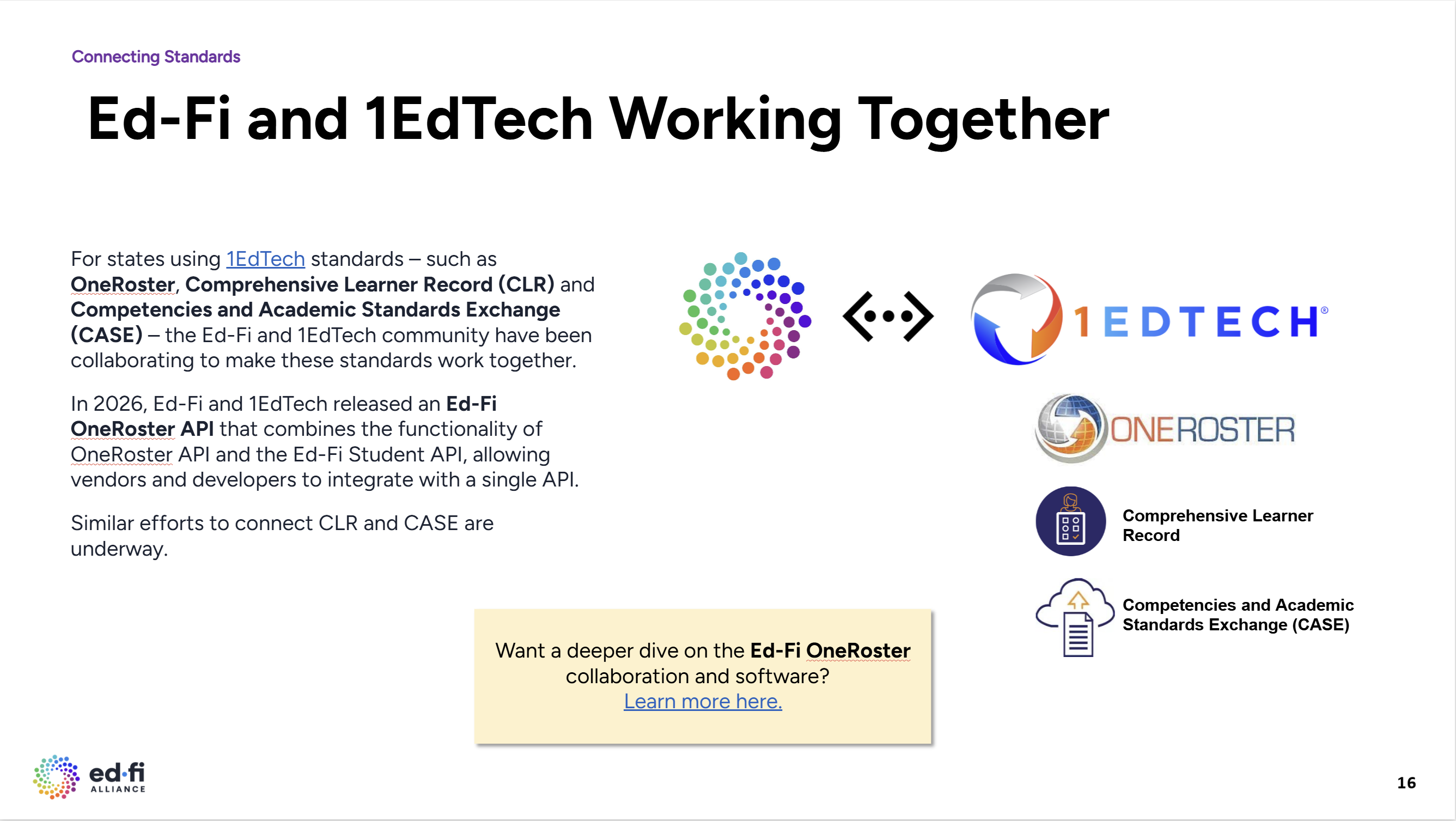
Ed-Fi and 1EdTech Working Together
Implementation
The Four Stages
Best practice is to reach production within two years. A faster timeline reduces unnecessary waste and builds team confidence. With vendor awareness, use of MSPs, and access to well-known best practices, the timeline to production has become much more rapid than a few years ago.
Planning Phase (3 Months)
Stakeholder activities during planning:
- SEA — Plan the project; assemble internal and external expertise; launch key communications with LEAs and vendors
- LEAs — Understand the goals and impacts of the modernization project; initiate communications with their vendors
- Vendors — Understand the goals and impacts; initiate communications with LEAs
- ESAs (Data Hub) — Build business plans collaboratively with members; explore candidates for initial data services
SEA tasks proceed in three phases:
SEA goals: (1) Secure Ed-Fi expertise, (2) Align internal teams, (3) Launch key communications with LEAs and vendors, (4) Prepare for the pilot phase.
Engage Ed-Fi Expertise
Hire a badged Ed-Fi Managed Service Provider (MSP) or consultant early.
- MSPs dramatically accelerate progress — they have done this many times and understand hosting options, maintaining current Ed-Fi products, debugging integrations, and providing vendor support
- If you have a preferred vendor list, SEAs have successfully asked those providers to sub-contract with an experienced Ed-Fi MSP
- The Ed-Fi Alliance maintains a list of badged MSPs and can provide references from other Ed-Fi states
Rethink SEA Processes
Moving from file-based to API-based collection requires process changes:
| Recommended | Not Recommended |
|---|---|
| Perform required data snapshots on SEA systems | Require LEA vendors to do "as-of" dates or data snapshots |
| Plan reporting around continuous integration of LEA data systems with the state | Reinforce "reporting window" patterns and milestones |
| Think in terms of software release cycles and follow Ed-Fi guidelines for publishing specifications | Release late changes to specifications that vendors cannot accommodate |
See Recommended SEA Process Changes for API-based Data Collection.
Begin with Core Student Information Systems (SIS) Collection
- Start with "core" collections — enrollment counts/ADA, special services populations — and expand over time
- Choose enough scope to enable LEAs to transition from older systems and relieve burden
- Do not attempt all collections at once; scope can be added in later stages
Begin with Core
| Recommended | Not Recommended |
|---|---|
| Ask vendors to turn on the Ed-Fi core data submission and perform data gap analysis | Do the Ed-Fi mappings on your own with staff new to Ed-Fi standards |
| Follow Ed-Fi Descriptor Guidance for code sets in your specifications | Use Ed-Fi Descriptor values for elements critical to your collections |
| Train your staff on the Ed-Fi Data Standard using your MSP | Allow this process to take more than 2 months |
Data Hub is the Best Path to LEA Value
The SEA's goal during this phase is to recruit ESA interest and identify data hub pilots. ESAs should:
- Bring internal leadership on board
- Draft a business model
- Engage an Ed-Fi Managed Service Provider
Join the SEA Workgroup Meetings
The SEA Workgroup meets once a month;
- To provide a forum for the Ed-Fi Alliance to share working solutions and emerging concepts with the community.
- Enables SEAs to engage with peers to discuss best paractices and explore potential solutions to common challenges.
Pilot Phase (9 Months)
Stakeholder activities during the pilot:
- SEA — Running a live pilot with 5-10 LEAs to support internal data system updates and external vendor and LEA development
- LEAs — Pilot LEAs actively submitting data; attending trainings and using early support resources
- Vendors — Working with 2–3 customers to develop Ed-Fi API capabilities against an early draft of state specifications
- ESAs (Data Hub) — Selecting initial data services and securing funding; finalizing business plan
SEA goals: (1) Run a live pilot with 5-10 LEAs, (2) Develop initial vendor Ed-Fi capability, (3) Plan for the Parallel Stage.
During this phase, development teams begin updating dependent systems: validations, ETL/ELT to the data warehouse, and LEA reporting interfaces. Live data during a pilot dramatically accelerates development team progress.
Begin with the core Ed-Fi Data Standards
SEA data collection teams are accustomed to making their own data standard, but Ed-Fi is a community-governed cross-state standard.
Avoid trying to "fit" Ed-Fi into legacy standards or processes.
| Recommended | Not Recommended |
|---|---|
| Ask vendors to turn on the Ed-Fi core data submission and perform data gap analysis | Change Ed-Fi element defintions |
| Rewrite your SEA ETLs into downstream data warehouse and other data marts | Requiring Vendors/LEAs to do business logic calculations |
| Only extend the Ed-Fi model when essential | Extending the standard unneccessarily |
Extensions and modifications to the Ed-Fi data standards "feels right" to SEAs but... over time SEAs must '"undo" unnecessary deviations from the Ed-Fi data standard, as vendors and other open-source products that SEAs integrate with expect core Ed-Fi formats and not customized state profiles.
Updates to Data Architecture
During this phase. SEA teams will initiate work to update dependen systems.
In states with a mature data warehouse, use of the Ed-Fi data standards may not impact the warehouse, but the flow of data into the warehouse will change.
Typical changes to consider include:
- Changes to validations and validation system
- Updates to ETL/ELT to wharehouse
- Updates to LEA reporting interfaces
Live data flow during a pilot, dramitically accelerates the development teams progress.
Resolution Task Force Meetings (RTF)
API issues can be difficult to debug:
- The vendor software may have a bug
- The LEA mmay be entering data or configurations incorrectly into their SIS
- The state API may have an error
- ETC...
To cut through finger-pointing and make process, RTF meetings are essential to create ann agile state supprt system.
SEA-led vendor workshops bring together SEA staff, district data stewards, and a single vendor's technical and product teams together to identify and resolve issues.
Repeat this meeting until major issues are addressed.
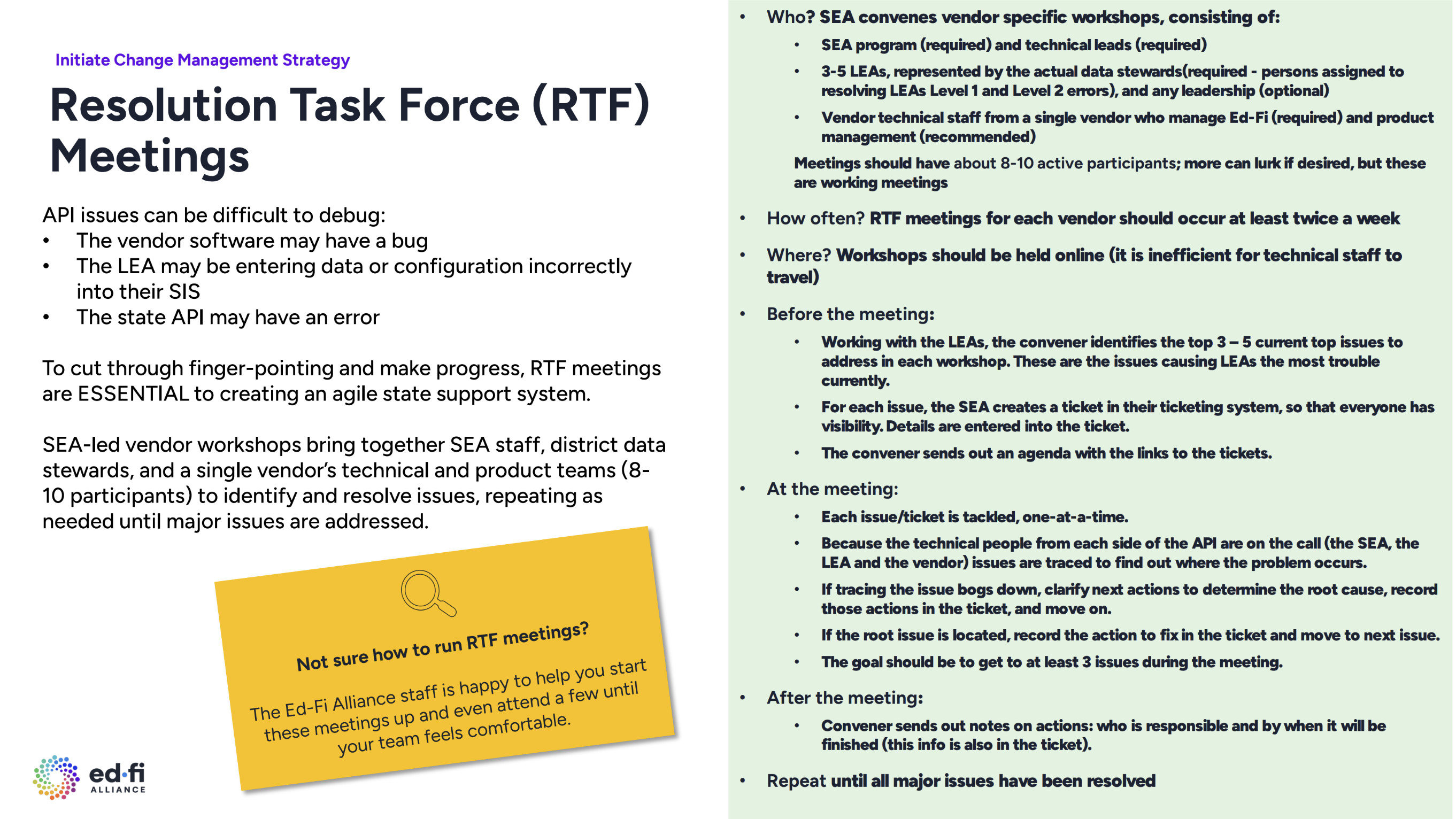
See Recommended Ed-Fi Data Governance Playbook: Resolution Task Force (RTF) Meetings Slide
Parallel Phase (12 Months)
Stakeholder activities during the parallel year:
- SEA — Running data collections with 20–30% of LEAs; benchmarking new against current system outcomes
- LEAs — 20–30% of LEAs actively submitting data; all LEAs attending trainings and taking local readiness actions
- Vendors — Working to support the final data specifications
- ESAs (Data Hub) — Launching initial data services; collecting initial revenue from LEAs; developing new data services
SEA goals: (1) Run parallel collections with 20–30% of LEAs to validate at scale, (2) Prepare dependent systems for production, (3) Update data specifications for the production year, (4) Invest in statewide LEA readiness.
Data Bootcamp Training
Level 1 & Level 2 Errors can be difficult to debug, as gthere are multiple systems involved:
- Utilize Vendor User Group Sessions
- Review Vendor API Submission Reports
- Review State Reporting/Validation Dashboards or Reports
- Identify Data Quality issues and re-submit data
Bootcamp trainings are an essential in creating an agile state support system.
SEA-led vendors workshops bring together SEA staff, district data sgtewards, and single vendor's product and technical teams to review priorities, gather feedback, and drive improvements at scale.
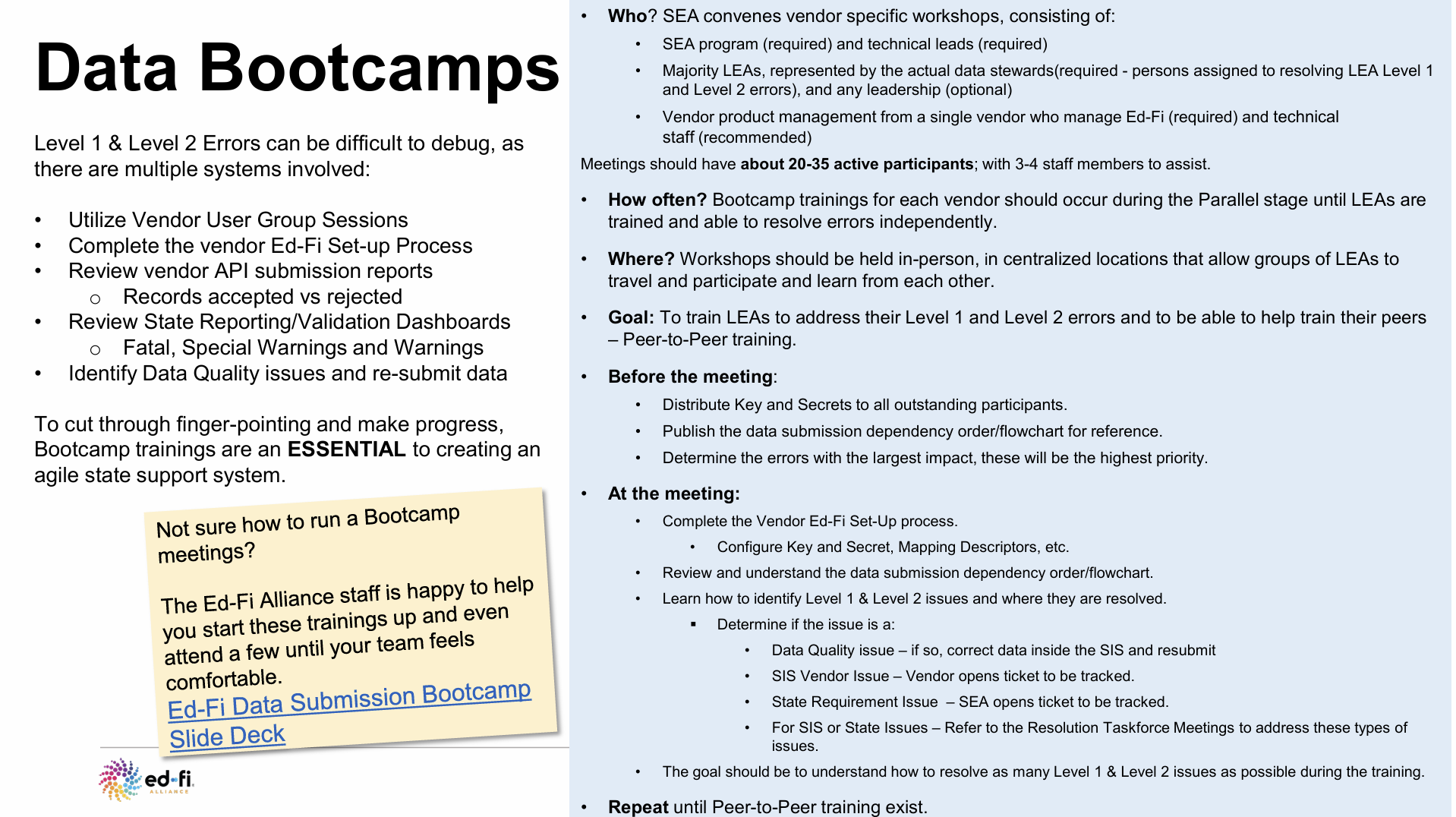
See Recommended Ed-Fi Data Goverance Playbook: Data Bootcamp Slide
Production Phase (Ongoing)
Stakeholder activities in production:
- SEA — Turn off the legacy system; establish an annual cadence for data specification updates; expand scope of modernized data collections
- LEAs — Allocate staff time freed up by reduced reporting burden to other valuable data-related tasks
- Vendors — Continue working with the state on the annual cadence of specification updates
- ESAs (Data Hub) — Expand scope of services, moving from operational services toward instructional support services
Implementation Best Practices
Technical Task Assignment
Recommendations for "Who does what?":
| Task | MSP | SEA |
|---|---|---|
| Handle all Ed-Fi technology components: ODS, administrative tooling, hosting, config, extensions, performance testing, etc. | MSPs have specialized expertise and stay current with the Ed-Fi technical roadmap | — |
| Determine the scope of the data specifications and initial targets | — | Requires a detailed understanding of outcomes and interacting with other teams at your organization. Best practice |
| Mapping your data needs into Ed-Fi data specifications | MSPs understand Ed-Fi details and stay current with Ed-Fi Data Standard updates | — |
| Publish and maintain an SDK for vendors | MSPs are familiar with the process and tooling | — |
| Design and development of LEA administrative interfaces | Options to consider: MSPs have development teams and experience in this area… | Options to consider: …your organization likely does as well, and has been maintaining this critical UX. |
| ETL/ELT to data warehouse | Options to consider: MSPs often understand the latest tools and techniques available for data pipelines… | Options to consider: …you may want consistency with how pipelines to the DW currently operate across your organization. |
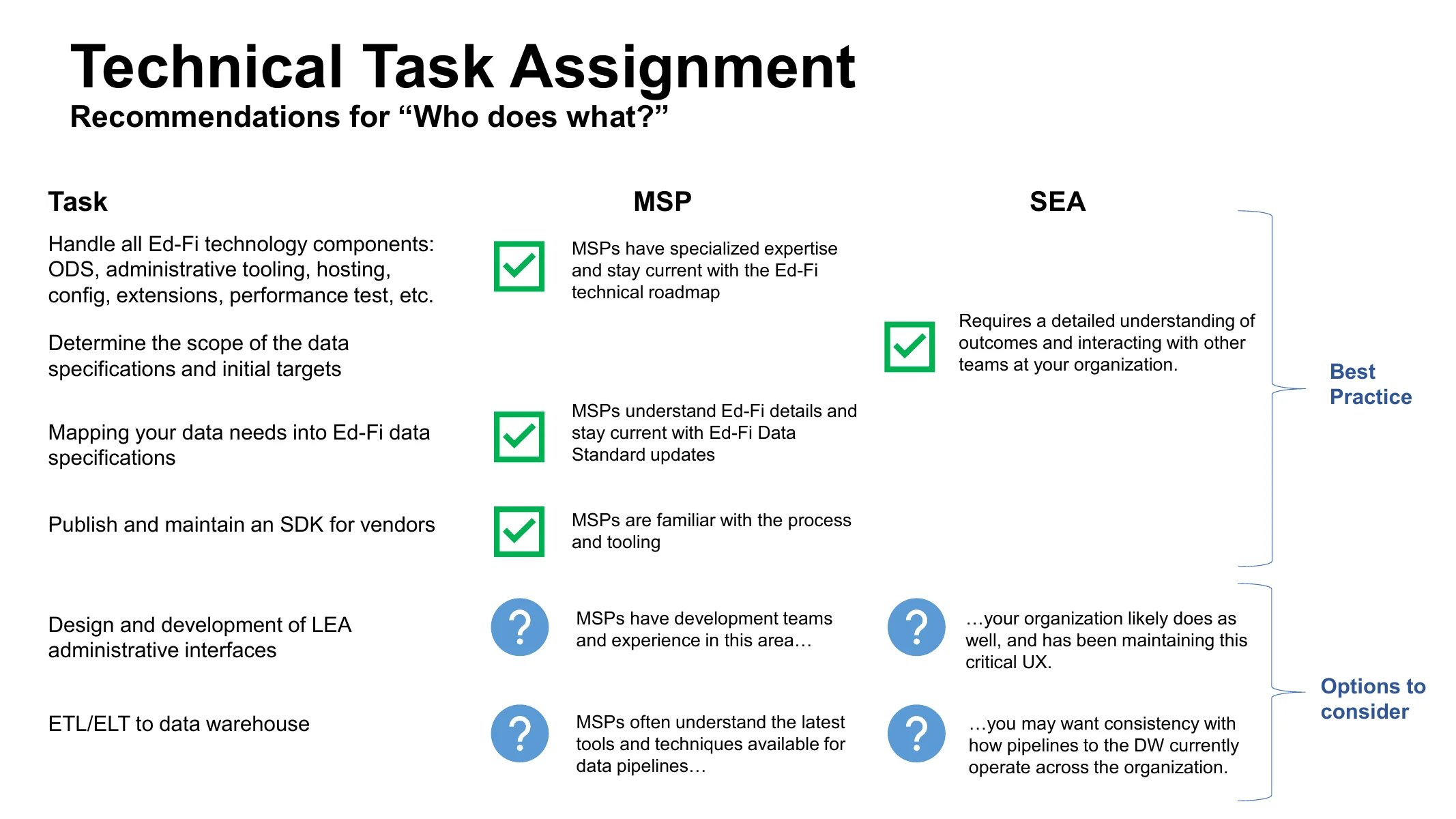
See Technical task assignment recommendations
Vendor Communication
Lead time best practices from field work:
| Milestone | Lead Time |
|---|---|
| Inform vendors of decision to use Ed-Fi and share a public project timeline | 6 months before pilot begins |
| Share initial data specifications | 3 months before pilot go-live |
| Publish data specifications for the parallel year | 6 months before parallel go-live |
| All future specification updates | 6 months before go-live |
Six Keys to Vendor Readiness:
- Provide a clear point of contact (person/email) for all SEA–vendor communications
- Create weekly one-hour calls open to the vendor community for project updates and Q&A
- Provide vendors public API sandboxes and other critical resources needed to build integrations
- Create a public view of vendor readiness and progress during the pilot and parallel year
- Provide vendors the Ed-Fi Alliance guidance on building API support and common error codes
- Involve vendors in data specifications review before the specs go live — vendors will have feedback that improves data quality and reduces burden on both sides
See Best Practices for Coordinating with Technology Providers.
LEA Communication
Four Keys to LEA Readiness:
- Enlist organizations or groups that currently support state reporting or SIS operations (ESAs, SIS user groups, hand-picked districts)
- Consolidate all Ed-Fi state reporting documentation into a single, easy-to-navigate website including links to vendor "how to" information
- With LEA permission, provide access to API errors and performance data to allow LEAs to participate in the continuous improvement process
- Publish guidance on API error codes and messages (same guidance as published for vendors)
See LEA Support - Turning on the LEA Data and Avoiding the "Error Flood".
State Data Portal
Allowing LEAs to see the data they publish to the state reduces support burden. SEAs should publish data back to LEAs via a data portal.
Critical portal components:
- Data Received — summary of data received, including counts for key areas (attendance, enrollment, other state-specified metrics)
- Data Usage — how the data will be used by the state: what are the impacts on funding or compliance?
- Last Update — when the data was last updated so LEAs know if their most recent changes were received
See Recommended SEA Process Changes for API-based Data Collection.